
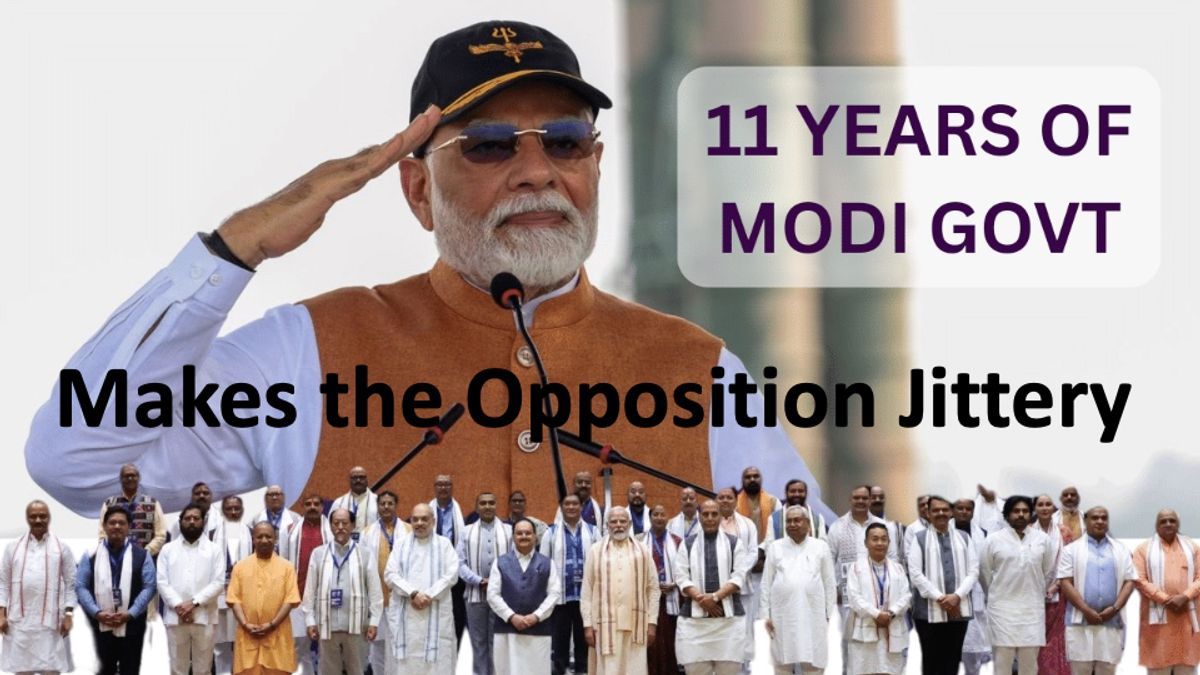
11 yrs of Modi Govt: Part-3: Modi-Model of Development
(This part of the article is in continuation of “11 yrs of Modi Govt: Part-1: The Honesty” available at https://thecounterviews.in/articles/11-yrs-of-modi-govt-part-1-the-honesty/ and “Part-2: Monetary Policies” available at https://thecounterviews.in/articles/11-yrs-of-modi-govt-part-2-monetary-policies/).
Introduction
PM Modi had been the Chief Minister of Gujarat for over a decade. In that time, he had implemented many development programs that were lauded as a model to follow for any and all CMs of all States that wished to prosper. After he assumed the high office of the PM, ‘Development of India’ was the first mantra of his governance thru’ his “Sabka Sath, Sabka Vikas”. As already emphasised earlier, India was struggling with sky-rocketing inflation, raining (or pouring) scams, policy paralysis, a very fragile economy, a rapidly growing unemployment, and the worse, a total lack of development. To begin with, Modi ‘picked and chose’ best of his advisors to reverse those trends as quickly as possible. He was rightly advised to invest on the infrastructures, considered a growth engine of any nation. He had many ‘Key Response Area (KRA) earmarked that were often threaded together for the best outcome. For example, if he developed a port, that would be connected with road, rail, Air and water ways links, with container handling capabilities as well as all allied services and facilities…something he coined in a term called “PM Gati-Shakti”, that provided speedy and effective implementation of the objectives.
He picked up a minister for road transportation and infrastructure development who subsequently came to be known as ‘Bhagwan Vishwakarma’ of the modern days. His soft-spoken and gentle approach was conducive for amicably finding a mid-path even on tricky issues and appreciated by one and all. Mr Nitin Gadkari really changed the pace and face of infrastructure development. It became a credit for PM Modi that whichever infrastructure projects he laid the foundation stones, he ensured its timely completion thru’ a strict monitoring, and inaugurated them for public use too. On Infrastructure projects, he proposed a key response area (KRA) for development as mentioned below:-
- Development of infrastructures, the wheel of economic growth.
- Development of the North-East States on high priority.
- Make India a manufacturing hub
- Focus on “Developed India” by the year 2047.
Infrastructure Development. The unprecedented Infrastructure Development of highways/Railways/Airports/Waterdromes/Sea-ports in the nation is glaringly visible. In last 11 yrs alone, 54,917 km of National Highway has been added. Similar progress are for several Expressways and State highways too. Connectivity to numerous many cities and boarder areas in the North-East States have been remarkable thru’ roads, Rail and air. Development of Border Roads all along Line of Control (LoC) with Pakistan and Line of Actual Control (LAC) along Tibbet, long neglected by Cong & UPA govts, has been one of the Key Response Areas (KRAs) of Modi Govt since 2014. Remote but highly strategic points like Kargil, Tawang (Arunachal), Nathu La (Sikkim), Lipulekh (Uttarakhand) and Daulat Beg Oldie (Ladakh) have been connected through broad and sturdy roads on which even combat armoured veh and Tanks could be transported. Monumental infrastructures of the likes of National Highways, Several Expressways,Sagarmala, Golden Quadrilateral and Navi Mumbai ‘Atal Setu’, Dwarka ‘Sudarshan Setu’, Bogibeel Rail-cum-road bridge over Brahmputra etc etc have been built in a relatively short time. Besides, connectivity to the smaller towns, hamlets and villages in all parts of India have been given due priorities in coordination with the respective state govts. In this regard, modification in the existing rural MNREGA scheme has transformed the infrastructure development that are worthy too.
On the road infrastructures, making numerous Hi-Tech modern tunnels across Himalayan mountains (like Atal Tunnel thru’ Rohtang pass, Se La tunnel in Arunachal, parallel road to Jawahar tunnel etc etc have already been completed and many others across Zoji La and some other mountains nearing completion) have ushered-in a new era of all-weather connectivity to even the remote parts of Jammu-Kashmir, Laddakh, Himachal, Uttarakhand and Arunachal Pradesh.
First thing Modi Govt did for the railways, was to get rid of the open foecal dropping from the passenger rail coach toilets. This vastly improved the hygiene sanitation of the rail tracks and freed the platforms and stations of stinks and horrible looks that India had been living with for ages. Another leap in the infrastructure connectivity has been the extension of rail services to all states Extending to the interiors of J&K, the North East as well as the important border estts. Rail connectivity to J&K has been a monumental showpiece for the world with highest rail bridge in the world (read “Monumental Chenab Rail Bridge: Great pride”, https://thecounterviews.in/articles/monumental-chenab-rail-bridge-great-pride-but-some-missed-opportunities-too/). Kosi Rail Mahasetu is another landmark rail bridge in Bihar over river Kosi. By now, Rail services have been far extended in East, West, North and South of the nation to Ledo, Naliya, Baramula, and Kanyakumari respectively. Metro services have been extended from 4 to 21 cities in 11 yrs of Modi govt. A modern Vande-Bharat Rail service of fully indigenous, faster and more comfortable coaches have been started connecting all major railway stations (read “Vande Bharat: A feather in Railway’s Cap”, https://thecounterviews.in/articles/vande-bharat-a-feather-in-railway-cap/) as well as we have seen the beginning of the Japanese Bullet Trains on a smaller section. In addition to the above, many freight corridors have been created for goods trains for faster transportation. Some of the bogies in these goods trains have even cold storages. Attention has also been given to extend the railway links to the neighbouring nations of Nepal and Bangladesh.
Other than the highways & railways, airway has seen the unprecedented growths in the last 11 yrs. Before Modi assumed office of PM, there were only 74 airports in the nation. Today, there are 147 larger and smaller airports incl those for remote connectivity under project UDAN. Besides, there are 13 Heliports and 2 waterdromes too. Some of the busy cities have got additional airstrip to ease out the traffic. Also, there are many dual purpose national/State highways that have been provided with a special type of built to enable landing and take-off of the combat and transport aircrafts under emergency situations. Today, there are efforts to connect the major ports with all links of connectivity under the flagship program of ‘PM Gati-Shakti’ by coordinating various govt departments and stakeholders so as to be able to facilitate movements of essential and priority goods nationally and internationally.
Development of Long-Neglected North-East States. North-East 7 States had been long under neglect by Congress Govts because it had far fewer parliamentary seats to get national attention for priority development. PM Modi adopted a ‘look North-East’ program to develop those States. Infrastructures of highways, railways and airways were initiated and completed too. Road connectivity thru’ widening of the highways had been completed by 2020 itself. Rail connectivity of Itanagar (Arunachal), Sairang (Aizawl), Imphal (Manipur) have already been linked and work is nearing completion on Zubza (Kohima, Nagaland) and Rangpo (Gangtok, Sikkim). Only Meghalay govt has been dragging their feet owing to lack of willingness among political parties. All these state capitals have already been connected by airports ie Guwahati (Assam), Agartala (Tripura), Donyl Polo (Itanagar, Arunachal), Imphal (Manipur), Shilong (Meghalay), Lengpui (Aijawl, Mizoram) and Dimapur (Nagaland). Industries mostly under tourism, MSME and handicrafts have been given priority. Higher educational institutions/universities in these states have facilitated the youth in higher studies in own states. Regional promotions centres have been set-up along with several other projects and completed on priority too, to make the people of the region feel that they had equal stakes in the nation. Set up in year 2000 by PM Bajpayee, the North Eastern Space Applications Centre (NESAC) at Umiam (20 km from Shillong) has been instrumental in mapping of forest gap areas, expansion of land area for horticulture development, identification and rejuvenation of wetlands, diversion of floodwater and assessment of bamboo resources for livelihood needs.
There is no doubt that Modi Govt has done a lot for the north-east states BUT more needs to be done to check the illegal infiltration from Bangladesh and Myanmar. Further, many separatist and terror groups operating in these states are creating both national and international security challenges that need to be dealt with firmness. Today, Manipur is the burning example for security beef-up.
Making India a manufacturing hub. It is a laudable achievement for Modi Govt to have made India a hub centre of manufacturing of some of the finished products under ‘Make in India’ or ‘Made in India’ programs. India is already the 2nd most manufacturing hub for mobile phones and 4th for Automobile sector. India is making state-of-the-art Tejas Combat aircraft and Rudra Combat helicopters. A unique Public-Private partnership (PPP) has been created to boost the manufacturing capacity of the combat aircrafts. India is also making transport aircraft C-295 under license and ToT programs. After obsoletion of HPT-32 and Kiran Mk-I & II, HJT-36 trainer (Yashas) has also entered manufacture after certification. Similarly, manufacturing has also caught up in Naval and Army Combat assets be it Aircraft carriers, nuclear and conventional submarines, surface warships, Arjun Mk-I Tanks, Zorawar Tanks, ULH & ATAGS Howitzers, assault rifles and so on. Manufacturing of semi-high speed Vande Bharat trains with luxury coaches have transformed the Railways.
In addition, India is on the way to ‘Semiconductors Mission’ and Lithium extractions. In fact, India is fast catching up in various sectors of manufacturing such as Pharmaceuticals, Textiles, Chemicals, electronics along with many others. Improving the quality of products and services to attain international standards must be adhered to. Since India is progressing with an objective of becoming large economy, manufacturing will have to contribute nearly 25% of the intended GDP and it is well on course.
Focus on “Viksit Bharat”. Beyond all above schemes and actions, Modi Govt has initiated an ambitious objective of making India a ‘Developed Nation’ by the year 2047, 100 yrs after its independence. It is not an easy task but Modi believes in thinking big. As it seems now, the govt is progressing well on all the parameters of a developed nation (read “Viksit Bharat: What it means?”, https://thecounterviews.in/articles/viksit-bharat-developped-india-2047/). Some of the developed nations are getting perturbed as their long dominance over India is bound to end but Modi govt is undeterred. There is an all out effort to raise India and its ethos to a height that it deserves. He is strengthening India from the grassroot levels of every State and that is how the nation will become developed.
Miscellaneous Other Development Planks
Besides the above few, Modi’s Development Plank has been extensive that did not neglect any sector or department of his government. Besides Roadways, Railway, Airway and Waterway development, he developed several other sectors too. He developed Foodparks, Defence & Religious corridors, he put much emphasis on higher education and vocational training too in line with his objectives of ‘skilled India’. In a very short time, he established several new institutions in the likes of 7 IITs, 16 IIITs, 7 IIMs, 15 AIIMSs. Coordinating with states, he helped increase medical seats from 51,000 in 2013-14 to 1,07,000 in 2024-25 of UG section and from 31,000 PG seats in 2013-14 to 70,000 in 2024-25. He emphasized to upgrade most of the district hospitals to Tertiary level. In the similar way, technical education in the nation got a much needed boost in both quantity and quality. He also boosted the Sports infrastructure in the nation, made exclusive sports university and infused sports culture among the youth thru’ “Khelo India” initiative. There has been massive increase in the funds for sports activities.
In addition, all ailing industries have been given new lease of lives by upgrading its outdated machines and bringing in newer technologies in producing fertilisers, oil refinery, food processing and so on. New institutions of higher education have been added in the last 11 yrs in the form of numerous AIIMSs, IITs, IIMs, Engineering, Medical & Ayurvedic Colleges, Sports Universities etc are only a few enumerated here.
In a Nut-Shell
Modi Govt has given a much needed boost to the Development of India. His govt has done remarkable job in the infrastructure sectors be it highways, expressways, border roads, railways, Airways or the Waterways. North East States of India have received a lease of life by numerous developmental projects. Manufacturing sector is growing at the highest ever rate. In additional numerous many departments have been brought on the development plank and none are neglected. In short, India is very much on course to “Viksit Bharat” path.