
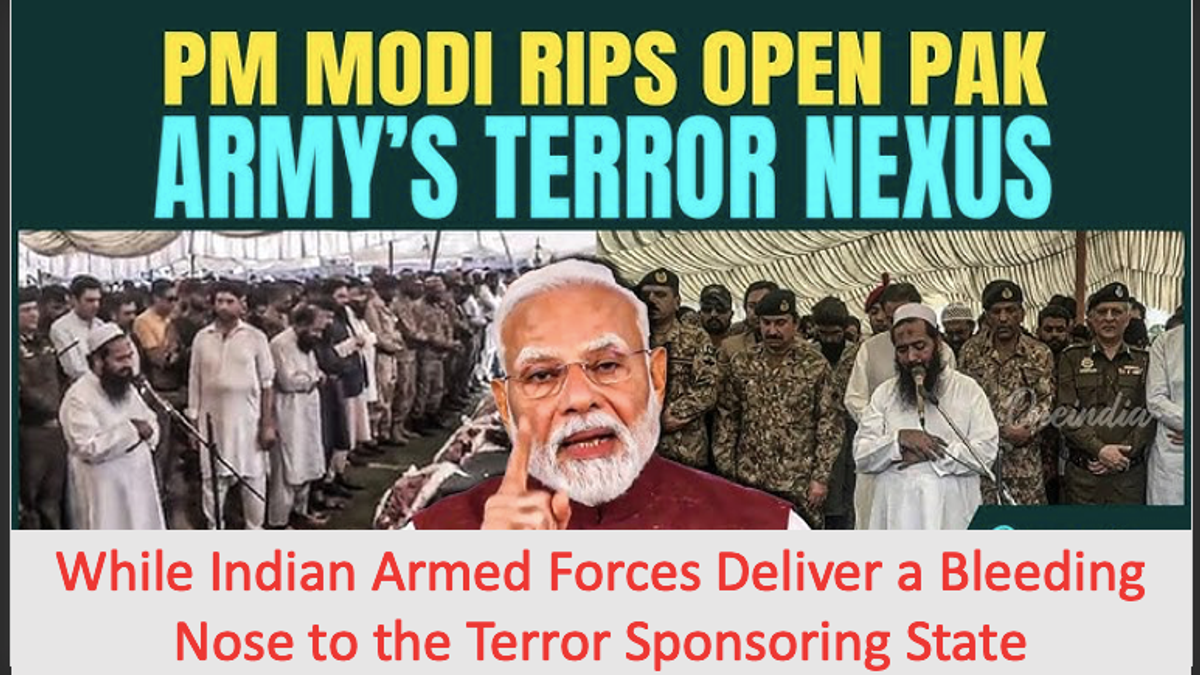
Pakistani Jihadi-Army Nexus; Op Sindoor and Defending India
Introduction
Indian Airspace was violated by Pakistan on 7th May 25 after their network of Jihadi terror active against India was targeted in ‘Op Sindoor’. Op Sindoor was launched by Indian Armed Forces after series of numerous jihadi terrorist attacks coordinated by Pakistan based terror groups, the trigger point being the killing of 26 Hindu tourists in Pahelgam on 22 Apr 25. The resistance Front (TRF) a Pakistan based offshoot of Islamic Terrorists group called Lascar-e-Taiba (LeT) took the responsibility for Pahelgam dastardly attack. The list of major jihadi terror attacks in J&K on civilians & military pers in the recent years are enumerated in the table below. It must be realized that beyond this list, Paki-based jihadi organisations have also indulged in targeted killings of numerous many Kashmiri Hindus in the recent years. Hence, Indian security forces must have been contemplating for a long to attack the Jihadi groups and Pahelgam attack provided the trigger.


It is believed that all three services coordinated the attacks on LeT and some other Paki Jihadi organisations who had earlier attacked our forces and civilians. The nine Pakistani Jihadi bases selected for attacks must have been a very carefully crafted plan under extreme secrecy that is why such excellent strike results were obtained. This operation of the Indian Armed Forces against the Jihadi network was named as “Op Sindoor” because jihadists had killed the Hindu husbands of our women who adorn Sindoor (vermillion) as a sign of being married. Jihadists deserved being killed in their respective hideouts. “Op Sindoor” was conducted successfully with absolute perfection in the early hours of 7th May 25. The way strikes were planned and executed on the nine jihadi hideouts and their headquarters; it will be inscribed in red letters in the entire military history of the world. Since Paki Jihadists have been the State assets of Pakistan, their Armed Forces were compelled to mount aerial counterattacks on Indian positions that led to the war, limited though.
Hindus under Islamist Attacks in India
India has been a target of Pakistani Jihadists duly supported by both their Army and Polity. Indian territories have regularly been violated by their Jihadist elements whether in Jammu & Kashmir (J&K) or elsewhere. India has faced many Jihadi terror attacks leading to mass casualties…be it 26/11, serial bomb blasts in Mumbai /sub-urban trains, attacks on Indian parliament or the likes of. Since large Muslim population of J&K sided with the Jihadists in 1990 genocide of the Pandits, those supports continue even today, in a depleted form though. This enables the Jihadists both from across the border or the home-grown, continue indulging in jihadi activities.
The violence being witnessed in J&K is not the militancy alone, it is a low-key jihad. Many politicians and govt in past, have tried to feign ignorance to this fact and therefore, the root cause of the atrocities on Hindus both in J&K and other Muslim dominated parts of India remain unaddressed. Killing of innocent Hindus in Pahelgam has not been in isolation. There has been a chain of events leading to it. The worst misfortune of Hindus is that their politicians greedy of ‘Muslim Vote-Bank’ remain inimical or indifferent to them. For them killing of Hindus hardly mean anything; whether it be Bengal (Telinipara, Sandeshkhali or Murshidabad), Bihar (Purnea), UP (Sambhal, Kairana, Merut, Muzaffarnagar), Kerala, Jharkhand, Rajasthan, Maharashtra, Telangana-Andhra to name a few. Islamic agenda of Gazwa-e-Hind has been going on with tacit support of Islami-boot-licking politicians and their political parties. A divided and indifferent Hindu community continues being persecuted in own homeland. In the recent years, there is seldom any Hindu religious festival that radical Muslims have not attacked. In fact, many Pakistani Jihadist-cum-Terrorists get active support from Indian Muslims.
Involvement of Pakistan-based Terrorist Groups
Of the numerous jihadi attacks directly or at the behest of Paki terror groups in the past, 22nd Apr 25 Pahelgam massacre triggered a backlash by India. PM Modi cut short his visit to Saudi to take stock of things. An urgent meeting of Cabinet Committee on Security (CCS) was called in which Govt of India took a firm resolve to strike the responsible terror groups to send a clear message, “Henceforth, you will pay dearly for terror attack within India”. Some strong diplomatic and economic steps too were initiated by the concerned committees to make Pakistan bear the cost of State-sponsored Jihadi terror. Indian Armed Forces was put on high alert and tasked to strike those responsible. Initial investigation by National Investigation Agency (NIA) as well as the claim by a Paki-based terror group ‘The Resistance Front (TRF)’, an offshoot of Lascar-e-Taiba, indicated their involvement. Out of the >100 Terrorist groups in Pakistan, about 60 are home-grown, of which about a dozen and half are mainly India-centric, the prominent of which include Laskar-e-Taiba, Jaish-e-Muhammed, Hizb-ul-Mujahiddin, Hakat-ul-Mujahiddin, Harkat-ul-Ansar, Harkat-ul-Jihad, Al-Badr, Al-Barq, Al-Faran among some others. Besides, Pakistan has more than 140 of the UN proscribed terrorists shielded by the State administration. It is also well known that Jihadi organisations easily change their names and affiliations if proscribed.
Op Sindoor
Indian Armed Forces planned a Tri-service attack on the Pakistan based concerned terror groups under ‘Op Sindoor’ and carried it out in the early morning of 7th May 25 with absolute precision. Nine high value terror targets were struck, each hit by several missiles. The myth was broken that LeT terrorists in their Muridke HQ as well as JeM terrorists in their Bahawalpur HQ were safe under protection of Pakistani Army. The attacks were so precise that all terrorists living in those hideouts had no means of escape, and were killed. In addition, terror bases in Muzaffarabad and Kotli were also hit inflicting huge casualties on the terrorists. This must have rattled the entire Jihadi network, their ISI coordinators and Paki Army. The major Jihadi groups and Paki-ISI must have prevailed upon their Army to launch counter attacks on Indian positions to be seen as retaliation.
Rattled, Pakistani Armed Forces launched numerous arial attacks all along the International Border (IB) and the Line of Control (LoC), with Drones and Missiles, both from surface and air. It is believed that their Army didn’t cross IB or the LoC. However, hundreds of drones and missiles attacks were launched by Pakistan on Indian military and civilian bases at Amritsar, Faridkot, Ambala, Agra, Awantipur, Bikaner, Halwara, Jodhpur, Jaisalmer, Pathankot, Bhuj, Srinagar and Uttarlai. Besides, there were heavy small & medium arm firing by Paki troops all along the LoC, many of them targeting civilian habitats. At some places even artillery firing was resorted to. These were clear acts of war and Indian military although largely defensive, responded with befitting replies.
The Robust Indian Air Defense
It was well known from the Balakot experience of 2019 that Jihadi terrorists under the command of Paki-ISI are the State assets of Pakistani Armed Forces that will compel their Army and Air force to mount counter attacks. Hence, Indian Armed Forces wanted to take no chance this time and were fully prepared. Thanks to the several layers of Air Defense Systems both imported and indigenous, that were available with our Armed Forces which were effectively deployed around the important Service Bases, vital installations and assets in the 12 days of preparation before the 7th May Strike on Pakistani Terror Camps. It must have been a demanding exercise for them to redeploy their Air Defense assets in vulnerable locations and they did it very well.
The waves of drones and missiles launched by Pakistani Army were surprising. However, knowing very well that China had provided them the attack drones as well as Turkey had supplemented them with both drones and soldiers to handle those assets, the swarms of drone attacks were very much expected. Most of those threats were largely neutralized by highly effective Indian Air Defense Systems, some integrated to form “Aakash Teers”. Seldom anything could penetrate the multi-layered Air Defense. What was apparent that varying categories of threats were neutralized by proportionate capability air defense systems…smaller drones with D-4 sys, L-70 & Z-23 cannons, larger drones with both cannons & smaller rockets, larger drones with Aakash Teers and enemy missiles with Barak-8 and S-400 advanced air defense systems. It is possible that IAF’s OsAK and Tunguska might also have knocked out some. Since enemy aircraft didn’t violate airspace, large many assets of QRSAM, Pechora, OsAK, Spyder, Kub, Strela, MANPADS etc did not have to come into action. The nation was proud to its excellent performance which at the first look gave an impression of the Israeli ‘Iron-dome’ which is considered impregnable.


Cessation of Hostility
After many Paki Air Force bases were hit by Indian missiles launched both from airborne fighters as well as by the ground-based Missile Squadrons, Pakistani leadership approached many nations who could have got India to agree for a ceasefire. It is believed that on their request US Secretary of State had a talk with his counterpart in India who must have consulted the core group within the Govt. Since Indian objectives of ‘Op Sindoor’ was already achieved and a tit-for-tat handed over to Pakistani armed forces for their act of war, the Govt could have seen no objection in agreeing for a pause if the proposal came from the other side. Surely, a request came from the Paki DGMO to the Indian counterpart and the pause in military action was halted in the evening of 10th May 25. Many Indian experts & analysts in military operations did feel a bit let down that Pakistan should have been given a bleeding nose for starting the war at the behest of their Jihadi organisations. However, violations in the pause quickly escalated all along the border by around 7:45 pm (IST) on that day itself and what followed was unprecedented. Indian Air Force and Army delivered the much desired knockout punch to Pakistan. It is believed that many Pakistani airbases were hit badly with many aircrafts knocked out. There was also a rumour of radiation leak from one of the Pakistani nuclear reactor but the Indian spokespersons expressed unawareness to it. Thereafter, Pakistan realized its folly and didn’t indulge in any further violation of the pause.
On 12 May 25 evening the two DGMOs had an elaborate talk on the hotline and a pause in ‘Op Sindoor’ was agreed on a condition that if Pakistani Jihadists indulged in any further act of terror within India, it will be considered as an act of war and Pakistan will bear its consequences. This is a new normal in Indo-Pak relation and the myth of Paki N-button is silenced forever. PM Modi briefed the nation on the same evening re-emphasizing that it was only a pause and not a ceasefire.
An Extensively Challenging Indian Airspace
Defending airspace over own territories is vital for any sovereign nation. India having 22,717 km of perimeter, of which 7517 km is the costal line, makes a significantly large stretch of air space to defend. Defending such complex and extensive air space is challenge in itself because it has a traditional enemy called Pakistan and a traditional adversary called China threatening its western and northern borders respectively. Even more challenging is defending the costal line that extends 20 km outwards to the limits of the territorial waters. The Air Space over the Exclusive Economic Zone (EEZ) extending up to 200 Nm becomes essential to protect own marine assets. Protecting the EEZ extending up to the international waters having valuable assets, has Operational significance. In addition, projection of Military power into the Sea discourages enemies from posing threats to the national boundaries. It is for these varied reasons that protection of Air Space far beyond our own assumes larger significance. In direct terms, Pakistani threats to our EEZ with possible assistance of Chinese military is a possibility from their Naval bases Gwader Port as well as the two leased out islands of Bundal and Buddu, to the Indian ONGC’s offshore assets.

In the aftermath of 1971 splitting of Pakistan, national defense has assumed even greater significance, not that India was any safer before. Having faced Pakistani invasions in Jammu & Kashmir in 1948-49, annexation of Aksai Chin by China in 1959, invasion by China in 1962, Pakistani invasion of 1965 amidst some other minor incursions by our enemy nations on northern and western borders, Indian territory has always been vulnerable. It was great for the Indian Armed Forces to have defended the nation in the simultaneous two front Ops over East and West Pakistan. However, failure to exchange PoK with the huge POWs captured, it was one of the greatest diplomatic military failures of the contemporary Indian govt. Untrustworthy neighbors on both western and northern fronts have been a reality with recent entry of another radical neighbor on the east. In addition, Pakistan having been cut in two in 1971 war, had taken a resolve to bleed India with thousand cuts through their terror establishments duly supported by the State.
India has been under constant threats of both Military and Jihadi elements for decades all around its perimetry with sole exception of Bhutan. Having been defeated repeatedly on war fronts, Pakistan has been resorting to various nefarious activities through their Jihadi elements from 3 fronts namely LoC, Nepal and Bangladesh. Lot many Pakistani jihadists were killed in the 1990s at the LoC. Thereafter, they started using Nepal and Bangladesh routes as conduits for Jihadi infiltrations. China has been helping them with sub-surface drilling machines under the barbed fence at the LoC as well as providing weapons enabling their terrorists to infiltrate into India. It is in the PLA’s interest to keep India pre-occupied with Pak-sponsored jihadi attacks as well as Communist supported Maoists & Naxals.
After Modi govt came to powers, strict actions were initiated against the terrorists and their handlers in Pakistan. Art 370 of Constitution was abrogated so that both Defence & Home Ministry were able to act freely to curb Islamic terrorism in J&K. Even if some terrorists infiltrated, they were detected and largely eliminated in relatively short time. Home grown terrorists in J&K are believed to have a very short life span of few months. Yet, infiltration continues to support a low-key jihad in the state. In the last few years, desperations have run high on the Jihadi organisations of Pakistan unable to achieve their objectives. On their request, both China and Turkey have armed them with low-cost smaller drones for two purposes. Firstly, to undertake reconnaissance of low threat areas for infiltration. Secondly, to Smuggle arms and ammunition to their Over Ground workers (OGW) within J&K and some part of Punjab so as to hand it over to the infiltrating terrorists as well as home grown jihadists. This is why, Punjabi helpers of Paki ISI-run Khalistani terrorism were unhappy when the home ministry had authorized BSF an extended 3-km of area of active vigilance within the IB or the LoC.
Far beyond the above challenges, Pakistan keeps uttering of its nuclear armaments saying they are India specific and will not hesitate to use them if threatened. Their nuclear blackmails have worked to some extent in the past. After their forces occupied the Kargil hilltops, the then PM Bajpayee directed the Indian forces not to cross the LoC. Further, when Pakistani jihadists mounted 26/11 Mumbai attack in 2006, the then UPA govt avoided attacking Pakistan on one or the other pretexts. Thus, Pakistan took it for granted that India will always yield to nuclear blackmails and their Jihadi wing under the command of their ISI will continue bleeding India without a reprisal. That myth was broken after Uri and Pulwama attacks when Indian Forces mounted surgical strikes on the terrorist launch pads, Balakot and Muzaffarabad, some well deep inside Pakistan.
High Value Indian Assets Needing Protection
The first and the foremost responsibility of any nation should be to protect its Strategic & Defence Assets & Infrastructures, high value economic assets & Infra, vital links and communication, high value energy infra and its populace in general. Having fought 4 territorial wars and one thru’ the airspace, Pakistan is the prime enemy for India. Further, radical Islam prevalent in Pakistan makes them a permanent enemy of peace-loving Hindus the glimpses of which were evident in Pahelgam attack. India must take it for granted that Pakistan will try to attack in future too even if they got another bloody nose in the recent conflict. Pakistan will also try to incite the radical Islamic elements within Bangladesh to mount ideological jihadi attacks within India. On the other hand, China has an expansionist agenda to grab territories thru’ their traditional “two step forward, one step backward” approach that were evident in their Doklam, Pangong Tso and Galwan skirmishes. In addition, China may also use Nepal & Bangladesh to mount some nefarious activities against India. Hence, as a starting point India must build its defense towards the above but not limited to it.
Although Military doctrines suggest mounting debilitating attack on the enemy in the first strike itself to disable them to strike your valued assets, that may not be workable all times. An example of it was evident in a short Indo-Paki aerial duals in May 2025. India had credible force to debilitate Paki force, yet they chose not to do so. Then the next doctrine suggests defending your valuable assets. This is where a credible air defense system came in play that India exercised against the multi-pronged Paki aerial attacks. Pakistan tried to attack most of the Indian Air Force bases as well as Army Cantonments from J&K to Gujarat. They tried to strike deep up to Adampur and Jodhpur bases as well as national capital of Delhi. Luckily most of those attempts by smaller Drones, A2G and S2S missiles were foiled. Although Indian Armed Forces had credible firepower to bring Pakistan to its knees, those knockout punches were not delivered. Should any of the Paki missiles had got through the air defense system, significant losses could have been inflicted that were uncalled for.
Networking Indian Air Defense Assets
It is amply clear from the above facts that India surrounded by ideological enemies and adversary needs a formidable and well-coordinated Defence and Security Forces along with offensive and defensive technologically superior military hardware. The threats could come from outside the international borders or from the within itself. After the availability of internet, jihadist forces from abroad have been able to spit hate & venoms remotely among the internal radical elements, often inciting them. Therefore, both internal and external security had to be strengthened. Thanks to the present govt that rapidly fanning jihadi intent has been checked despite some backing by a few ‘vote-bank’ political parties. Thus, while smaller drones with explosives could be threatened by the anti-national and rogue elements from within, major attacks could be expected only from across the borders. While considering air defense system, we are not considering the jihadi ground threats.
Enemy Drone/Missile/Aircraft Threats
Drones. Pakistan has both small and medium-large drones of Chinese and Turkiye origins for attacking Indian assets hence, anti-drone system needs to be deployed opposite Pakistan borders at all important places. Turkiye supplied larger drones like TB-2 has to be countered by both anti-drone cannons as well as rockets & missiles. TB-2 has no chance of survival against Aakash Teer within its 30 km range or the other anti-aircraft missiles hence, it will not dare to come anywhere close to the Indian airspace. Short range Pakistani cruise missiles Hatf 1, 2 & 9 were believed to have been used in the recent conflict. A unified Air Deffense assets of both IAF and Army working in tandem was a perfect killer platform to neutralize Pakistani attacks. It was so effective that all enemy drones, rockets and missiles were shot down. However, in the future combat, drones flown by internal chips programmed to hit any fixed targets (at given coordinates) may be resistant to jamming. It is also possible that smaller Kamikaze drone airframes and fuselage may be made invisible to various Radars by Radar-absorbing surface paints being tried out. Those drones will be difficult to detect and destroy by air defense missiles. The countermeasures will have to be evolved continuously to meet newly emerging threats.
Aakash Teer is a system designed to automate detection, tracking and engagement of enemy aircraft, drones and missiles. It integrates various radar systems, sensors and communication technologies into a single operational framework. It gathers data from multiple sources, processes it and allows for automated, real-time engagement of airborne enemy threats. It is a mobile platform properly camouflaged to prevent enemy detection that can re-deploy at desired locations within a short time. It incorporates some of the undermentioned weapon systems.

Anti-Drone Air Defense Systems used in the present conflict included D4, modified L70, upgraded ZU-23 and ZU-23-4 Schilka, Tunguska guns…some integrated under Aakash Teers. Indigenously developed VISHORADS along with other MANPADS were ready for action but didn’t have much role to play because all types of enemy drones incl TB-2 Predator drones were already taken care of by the above anti-drone Air Defense systems. These systems could be positioned just beyond the range of enemy artillery fire. These anti-UAV systems should form the first layer of Air Defense for India. However, DRDO must make pro-active upgradations and value additions in the existing anti-drone/UAV air defense systems owing to the improvements being incorporated in the enemy drone systems mentioned above.
Enemy Aircraft. The next level of Air Defense should be against possible enemy aircraft intrusions with bombs, rockets, A2G or BVR missiles. The aim of deployment should be such that no enemy aircraft ever makes any misadventure of intruding into Indian Air Space. While some of the ground-based Radar detection systems have some limitations in detecting low flying distant objects, Airborne Early Warning Platforms can pick-up enemy aircrafts much withing their own airspace. Once detected, they can be destroyed by an array of own combat aircraft or Air Defense missiles, rockets and guns. Air Defense Missiles include both A2A as well as S2A missiles striking the enemy aircraft both within and Beyond Visual Range (BVR). Indian Air Force also has several combat aircraft that can prevail on enemy aircraft in close combat. Recently inducted Aakash S2A missiles having even ECCM that can beat any enemy aircraft bid to jam them. Once locked on to the enemy arial targets, they are sure to kill. A vast list of Air Defense Systems having vast capabilities to defend the Air force assets and infra are enumerated in the text box below.

In addition to the above Offensive Air Components, Indian Air force as well as the other two services already have several credible Air Defense systems capable of shooting down enemy aircraft intruding Indian airspace. The enemy aircraft may release their A2S missiles to attack the high value Indian assets or approach the target and try to drop bombs flying close to it. India has several air defense systems that can knock out the approaching enemy aircraft while still distant from the target. These air defense systems are already trusted weapons being used by both IAF and Indian Army. The list of the air defense weapons is mentioned in the text box below: -

Enemy Missiles
. Missile threats could be of the conventional or nuclear warheads. Any missile approaching over a high value military asset could be assumed as having conventional warheads in all likelihood. It also may have the so-called tactical nuclear warheads that will surely put the target area out of action for ever. India’s present nuclear doctrine is “No first use; and if attacked, Disproportionate Retaliatory strikes”. Nuclear attack of any type will attract retaliation, but the air defense systems must be able to knock out the in-coming missiles in the first place. Any Paki missile with its trajectory to larger cities could be expected to be a strategic nuclear warhead. Hence, it is imperative that all metro cities and major economic hub are kept under anti-missile umbrella of the air defense systems. It could be one or more missile defense system consisting of S 400, Pradyumna, Ashwin, Barak 8, MR/QR SAM or the Aakash as shown in the text box below.

India has a credible anti-missile defense system most of which are mounted on mobile platforms. Now, that the credibility of our missile shields is established, it is pertinent that it is deployed in adequate numbers to defend all our vital installations as well as of the assets of ‘Offensive attack forces’ in a possible two-front war. Its deployment may be made maneuverable according to the threat perceptions.
Nuclear Doctrine against Pakistan
Although it is not appropriate to elaborate national nuclear doctrine in public domain, Pakistan is a different case all-together. It is a rogue and radical nation born with hate against Hindus. They covertly acquired the nuclear warheads much before India, with their sole aim of attacking them. Even after testing their weapon a week after India did, they had openly stated that their nuclear arsenal is India specific, and they retained first strike option. This Paki claim may have been criticized by some but is worrisome. Pakistan is a failed state, with numerous Islamic terrorist groups thriving within and the nation itself at the brink of disintegration. There is always a possibility of the N-weapon falling in the hands of the terror group and then they could indulge in N-blackmails with catastrophic consequences. International bodies like UNSC even though ineffective at this juncture, must formulate an infallible SOP to prevent such happenings.
Many experts in Defence matters feel that while India may retain its ‘No First Use’ doctrine, it must make a Pakistan specific SOP of ‘Immediate disproportionate retaliation’ against any nuclear attack, be it tactical or strategic. Govt must make an SOP that should a nuclear attack by Pakistani Govt/Armed Forces/Terrorists take place, there should be a swift retaliation without wasting time on meetings/consultations/approvals. Even if the decision-making body having finger on N-button be knocked out, disproportionate retaliation should be swift…to knock out 3 cities namely Lahore, Karachi & Islamabad. A second wave of attack may take on Faisalabad, Rawalpindi and Gujranwala as well. Pakistani might must be crushed for ever after their misadventure. It is sure that if the retaliation is not swift and Indian decision makers waste time, UNSC, P-5 and the OIC-led international bodies will do everything possible to prevent India from credible retaliation. This must not happen.
The Bottom-Lines
Pakistan was born out of Jinnah’s hate against Hindus. That hate in Pakistani DNA remains even now. After the nation was severed in two in 1971 war, that hate has intensified even more, with a resolve to bleed India with thousand cuts and towards this, the State-sponsored Jihadi terror network is being used effectively for over 35 yrs now. In order to fuel the fire, anti-India policies of Chinese expansionism have been assisting Pakistan. On top of the above, a new radical State of Bangladesh has taken birth after overthrow of the previous regime. Thus, India is surrounded on many fronts with enemies, needs a robust Military might as well as Air Defense Systems.
Indian Armed Forces have exhibited its incredible Air Defense Systems against a brief arial battle against evil Pakistan in May 2025, inflicting them a bleeding nose. This perennial enemy will try to raise its head again in future. Indian military might must upgrade itself with a regular technological value additions to its existing weapons as mentioned in the article. Any complacency could be dangerous. Indian nuclear doctrine of credible deterrence may continue but a new Pakistan-oriented SOP will be desirable to be put in place for the enemy to be fearful while uttering the N-word.